

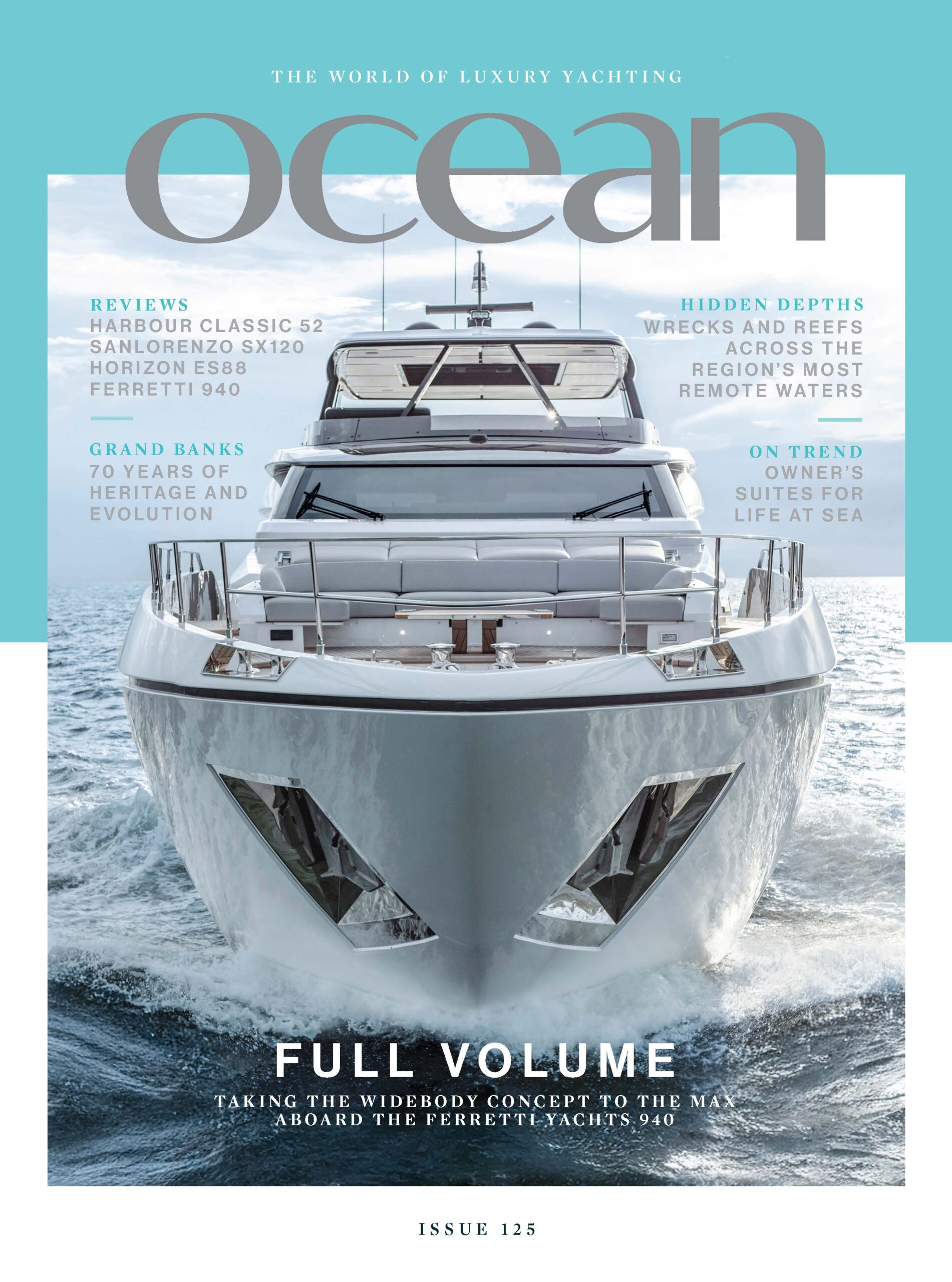
Sanlorenzo’s SX120 takes the crossover concept even further – Sam Fortescue finds the new flagship adds greater space, flexibility and a more resolved layer of design refinement, reinforcing the SX line’s evolution into a genuinely versatile long-range platform.
When Sanlorenzo launched the first of its SX crossover line in 2017, there was a collective intake of breath. Commentators lingered over the swept-back trawler-style windows and the innovative use of space in the debut 88-footer. Eight years and dozens of boats later, the concept is not looking quite so radical. Perhaps, inevitably, the rest of the world has caught up and the novel has become more established. Interesting, then, to see that the 36.6-metre flagship of the SX line, which premiered at the 2025 Cannes Yachting Festival, still has a few tricks up its sleeve.

The boat was announced in 2024 as the successor to the previous SX112, of which 25 hulls were sold – a phenomenal achievement for a big yacht. It reunites the design duo of Bernardo Zuccon on the exterior and Piero Lissoni for the interior, who have been responsible for the last three SX models, placing the new yacht instantly alongside her smaller sisters. “The SX120 completes a first stylistic journey, simplifying and optimising every line and shape,” says Zuccon. “A significant example is the counter-inclination of the forward windshield, compared with the verticality of the SX88, marking an important step in the evolution of the design language and making it even more harmonious and sophisticated.” So far, so familiar. You’ll have to look a bit harder however to find her chief point of difference and one of the things that placed her among the more interesting boats at Cannes. Under the aft deck, in fact. Because that’s where her Volvo Penta IPS Professional Platform drivetrain is hidden – reportedly, the first yacht to make use of the system.
Built around Volvo’s new heavy-duty IPS40 pods, the platform permits two input power sources for each drive. The SX120 uses twin D13-IPS2700 engines that can deliver 1,000 hp each, although an electric motor could also be used to create a hybrid set-up. It delivers a maximum speed of 23 knots but gives a range of 2,000 nautical miles at an economic 10-knot cruising speed. You might think it a stretch to describe a 36-metre yacht with 4,000 hp of propulsion as efficient, but the IPS system is said to offer superior fuel economy and greater manoeuvrability. It also has an eco mode, which adjusts engine power to optimise fuel consumption, balance run time and extend service intervals. “The system makes use of steerable units and hydrodynamically optimised counterrotating propellers, which allow a significant reduction in energy losses and a marked improvement in manoeuvrability, especially at low speeds,” confirms Nicola Pomi, Vice President of the Marine Sales Yacht and Superyacht Division at Volvo Penta. If mere economy is not enough, there are other benefits too: the steerable pods of the IPS system give this yacht the ability to turn within her own length. And by dispensing with the long shaft drives, Sanlorenzo can reduce the volume given over to technical space and put it to guest use instead. This gives rise to another attractive feature of the SX120, namely her huge aft platform and lower lounge. “The IPS40 system has freed up space below deck, making it possible to integrate a transformable pool in the beach area aft,” says Zuccon.

“Thanks to an innovative lift-andslide mechanism beneath the sunpad, the pool can be concealed when not in use, ensuring both exceptional aesthetics and functionality.” With its bathing platform raised and the pool covered over, there are 40 square metres aft for lounging, entertaining or even dining at the water’s edge. But hit a button and the side wings fold down, adding an extra 30 square metres to the aft real estate. The lower lounge can take advantage of it all, as the side wings reveal full-length glazing that lets the light flood in, and the glass transom slides open to give access to the aft deck. The longer hull has also permitted Sanlorenzo to add an extra deck without sacrificing the proportions of Zuccon’s exterior. What used to be the open-plan flybridge has become a true upper deck, with enough space to separate the dining area from the helm station with an attractive curved glass bulkhead. “With the extra deck, we have added a lot of square metres compared to the SX112,” says project manager Elena Sieti. And it doesn’t stop there, as there’s still room to exploit the hardtop for sun worship – a new feature on the SX line. A simple staircase from the upper deck opens onto a teak-laid area fitted with sunpads and reconfigurable lounge cushions. A low glass bulwark runs around the edge, providing a minimum of safety without adding any visible height, and there are sockets for the carbon poles needed to rig a shade-giving bimini.